
Why We Built Beyond Bazaar
Sourcing sounds simple until you actually have to do it. For businesses working in garments, textiles, and embroidery, a single production requirement can quickly turn into conversations with several different suppliers. One handles thread, another supplies accessories, someone else takes care of embroidery, and then there is another contact for machinery, spare parts, packaging, or printing. None of these suppliers are necessarily doing anything wrong, but managing all of them at the same time can make an already busy production process much harder than it needs to be.
That frustration was one of the reasons we started thinking about a different approach. We kept coming back to a simple question: why should a buyer have to deal with so many different suppliers just to get the things they need for one business?
The Problem We Wanted to Solve
The challenge was never really about a lack of suppliers. There are plenty of them. The bigger issue was the amount of coordination required from the buyer. Every supplier has a different process, different communication style, different timelines, and different way of handling requirements. When several products are needed at the same time, keeping everything aligned can become a job of its own.
We wanted to make that process easier. Instead of creating another marketplace where buyers could search through hundreds of suppliers and then manage those relationships themselves, we decided to take a more direct approach. We wanted Beyond Bazaar to be the supplier that buyers could actually work with, rather than simply the place where they found another supplier.
Starting With What Buyers Actually Needed
Beyond Bazaar did not begin with a huge catalogue or a long list of categories. It grew through real conversations with buyers and suppliers. We already had active relationships in the market, and as those relationships developed, buyers started asking us for things beyond their original requirements. A customer looking for one product might need another product for the same production process, and then something else for a future order.
Those requests started shaping the business.
Over time, our offering expanded into garment and textile accessories, embroidery manufacturing and services, embroidery machinery and spare parts, and packaging and printing solutions. These categories are different, but they are connected by the same underlying need: businesses need reliable access to the things that keep their production and operations moving.
We Chose to Be More Than a Marketplace
There is an important difference between giving someone a list of suppliers and taking responsibility for a supply requirement. A marketplace can help a buyer discover options, but the buyer still has to contact those suppliers, compare them, explain the requirement, follow up, and manage the order.
That is not the model we wanted for Beyond Bazaar.
Our goal is to build a direct relationship with the buyer. When someone comes to us with a requirement, we first try to understand what they actually need. If we can supply it directly, we do that. If it needs to be sourced, we work on sourcing it. If the requirement needs to be produced or arranged in a particular way, we look at how we can make that happen.
It is a more hands-on model, but we believe that is what makes a supplier useful.
Why We Keep the Team Small
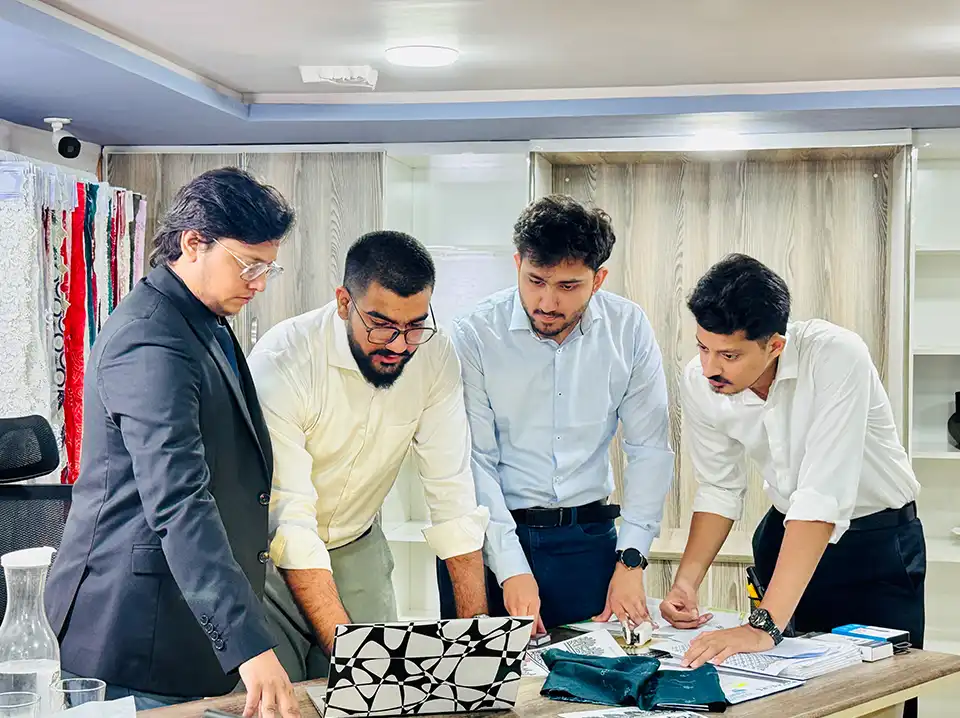
Beyond Bazaar operates from Faisalabad, Pakistan, with a small team working across sourcing, production, quality control, and buyer communication. We have deliberately kept the setup lean because we do not want unnecessary layers between the buyer and the people responsible for getting an order done.
A smaller team allows us to stay close to the details. If a requirement changes, we can respond. If something needs clarification, we can discuss it directly. If there is an issue that needs attention, there are fewer layers standing between the problem and the person responsible for solving it.
For us, being small is not something we are trying to hide. It is part of how we want to work.
Built in Faisalabad, With a Global Outlook
Faisalabad has a long-standing connection with textiles, garments, embroidery, and manufacturing. Being based here gives us access to an established business environment and a network of people and suppliers who understand these industries.
At the same time, we do not see Beyond Bazaar as a business limited to one city or one market. We want to work with wholesalers, factories, exporters, and international buyers who are looking for dependable supply from Pakistan.
For international buyers especially, finding a supplier is only the first step. What matters over time is whether that supplier understands the requirements, communicates properly, maintains consistency, and can support repeat orders without making the buyer start the entire sourcing process again.
That is the kind of relationship we want to build.
Growing Based on What Buyers Need
We are still early in the Beyond Bazaar journey, and that means the business is still evolving. We expect our categories, capabilities, and supplier network to grow as we learn more about what buyers actually need.
But we do not want growth for the sake of having a bigger catalogue. We would rather add something because there is a genuine demand for it and because we believe we can provide it properly.
That principle will continue to guide how we expand. If buyers need something we do not currently offer, we want to be able to have a conversation about it rather than simply saying, “That is not on our list.”
What We Want Beyond Bazaar to Become
At its core, Beyond Bazaar is about making sourcing less complicated. We want buyers to have a direct point of contact, a supplier that takes their requirements seriously, and a relationship that can continue as their needs grow.
We know that we cannot solve every sourcing problem overnight, and we are not trying to claim that we can. But we can keep building a business around being direct, dependable, and accountable.
That is the reason Beyond Bazaar exists. Not to become another marketplace with the biggest catalogue, but to become a supplier that businesses can rely on when they need something sourced, supplied, or simply figured out.
Beyond Bazaar was made around a pretty simple and, honestly, kind of annoying frustration that buyers in the textile and garment world already know.